
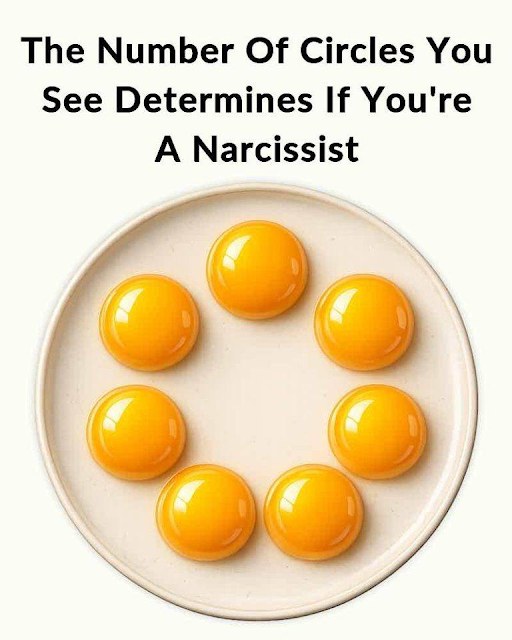
Do Optical “Personality Tests” Really Reveal Who You Are? The Truth Behind Viral “Circle Tests” and Psychological Labels
Every so often, a new visual puzzle spreads across social media claiming to reveal something surprising about your personality. One of the most common formats is deceptively simple: an image filled with overlapping circles, paired with a bold claim such as “The number of circles you see determines if you’re a narcissist.”
These posts often go viral quickly. People comment, share, and compare answers, curious about what their perception supposedly says about their personality.
But how accurate are these claims? Can a simple optical illusion really reveal whether someone has traits like narcissism?
To understand this, we need to separate three things:
visual perception
online personality quizzes
and clinical psychology
Why Visual Personality Tests Go Viral
Internet “personality tests” based on images—like circles, shapes, or illusions—are popular because they are:
simple to understand
quick to complete
and emotionally engaging
They give users an immediate sense of participation and curiosity. Unlike long psychological questionnaires, they require no effort beyond looking at an image and interpreting it.
The claim attached to them is often intentionally bold:
“This reveals your hidden personality trait”
“Only certain people can see this number of shapes”
“This determines if you are narcissistic”
These statements are designed to attract attention rather than provide scientific accuracy.
The Psychology Behind Optical Illusions
Visual perception is a complex process.
When you look at an image filled with overlapping shapes, your brain is:
detecting patterns
filling in gaps
interpreting depth and contrast
and filtering visual noise
Because of this, different people may notice different elements in the same image. This variation is normal and does not reflect personality traits.
Instead, it reflects factors such as:
see continuation on next page
ADVERTISEMENT
