
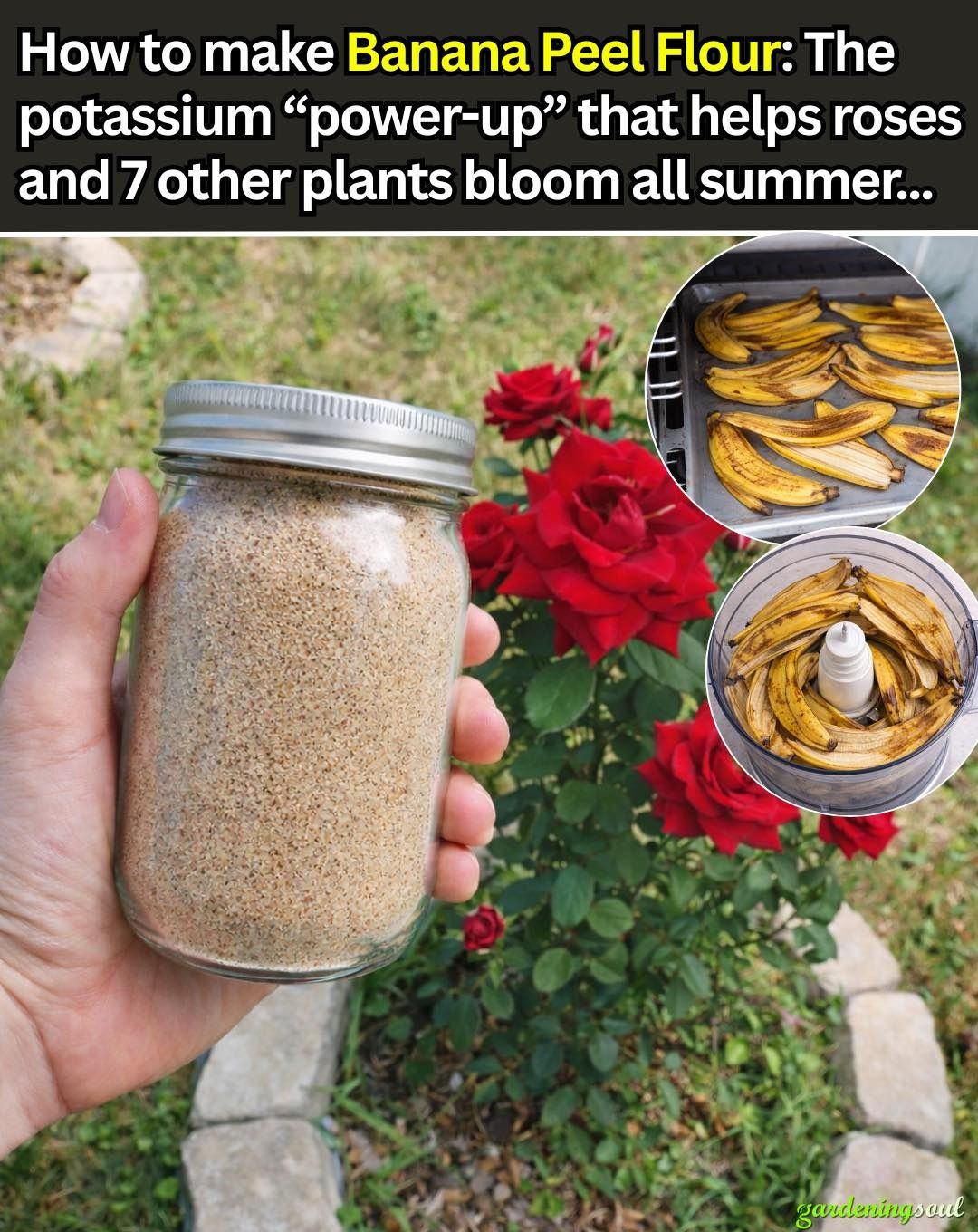
Banana peels are one of the most common kitchen scraps – and one of the most debated garden “fertilizers.” You’ve probably seen bold claims like “banana peels force roses to bloom,” “banana peel powder replaces fertilizer,” or “just bury peels and watch flowers explode.”
The truth is more useful than the hype: banana peels can contribute nutrients, especially potassium, but they work best when you process and apply them correctly and treat them as a supplement – not a complete fertilizer. That’s where banana peel flour comes in.
Banana peel flour is simply fully dried banana peel ground into a fine powder. This powder breaks down more evenly than whole peels, is easier to store, and can be incorporated into soil in measured amounts.
When used properly, it may support flowering, fruit quality, and overall plant resilience – especially in plants that appreciate a bit of extra potassium.
What Is Banana Peel Flour, Exactly?
Banana peel flour is dehydrated banana peel that has been ground into a fine powder. Unlike fresh peels, which are wet and fibrous, flour has:
- Very low moisture (so it stores well)
- High surface area (so soil microbes break it down faster)
- Even distribution (so nutrients release more consistently)
Gardeners like it because it turns a messy kitchen scrap into a measurable, slow-release amendment.
It is not the same as compost. Compost is already partially decomposed and biologically stable. Banana peel flour is still raw organic material that needs to be broken down in the soil.
Why Banana Peels Are Associated With “Bloom Power”
Banana peels contain a mix of plant nutrients and organic matter. The nutrient that gets the most attention is potassium (K)-one of the three major macronutrients (N-P-K) plants use in the largest amounts.
What potassium does in plants (and why it matters for roses)
see continuation on next page
ADVERTISEMENT
